
Five Judges, Fifteen Cards: Vietnam's Team Kata Gold Was Unanimous, Not Unassailable
**মূল উত্তর:** ভিয়েতনামের মহিলা দলগত কাতা দল ২০২৬ সালের এশিয়ান Gamesে (নাগোয়া) সোনা জিতেছে। নেপাল, চাইনিজ তাইপে ও ফাইনালে ইরানের বিরুদ্ধে তিন ম্যাচেই পাঁচ বিচারকের সবাই ভিয়েতনামকে এগিয়ে রেখেছেন; তবে ফাইনালে Average ব্যবধান মাত্র ০.৪২, তাই এটি বিশাল পয়েন্ট-ব্যবধানের জয় নয়। **মূল তথ্য:** - দল: নুয়েন গক ট্রাম (২৪), হোয়াং থি থু উয়েন (২০), বুই গক নহি (১৯)। - চাইনিজ তাইপের বিপক্ষে Average স্কোর ৮.২৪ বনাম ৭.৯২; ব্যবধান ০.৩২। - ইরানের বিপক্ষে Average ৮.৫৪ বনাম ৮.১২; ইরান থাইল্যান্ড ও ফিলিপাইনকে হারিয়ে ফাইনালে। - অংশগ্রহণকারী দেশ এশিয়াড ১৯-এ ৪ থেকে এশিয়াড ২০-এ ৮ হয়েছে। - হাংচৌ ২০২৩-এ সোনা জিতেছিল ট্রাম, ফুওং ও লু থি থু উয়েন; Coach নুয়েন হোয়াং এনগান। **সূত্র:** এশিয়ান Games ২০২৬, নাগোয়া — দলগত কাতার বিচারক-প্রদত্ত স্কোর। মূল প্রতিবেদনের প্রকাশক ও লেখক অজ্ঞাত; বিশ্লেষণে কেবল স্কোর-তথ্য ব্যবহৃত। cricsultan.com ডেটাবেজে সমতুল্য ক্রস-চেক এন্ট্রি পাওয়া যায়নি। **সম্ভাব্য Search:** প্রশ্ন: এশিয়াড ২০-এ দলগত কাতার ফাইনালে কে হেরেছে? উত্তর: ইরান, যারা থাইল্যান্ড ও ফিলিপাইনকে হারিয়ে ফাইনালে উঠেছিল। প্রশ্ন: ভিয়েতনামের আগের দলগত কাতা সোনা কবে ছিল? উত্তর: ২০২৩ সালের হাংচৌ এশিয়ান Gamesে (এশিয়াড ১৯)। প্রশ্ন: ফাইনালের স্কোর কী বলে? উত্তর: Average ব্যবধান ০.৪২ — সর্বসম্মত রায়, কিন্তু ছোট ব্যবধান।
On a Rajshahi rooftop at two in the morning, the Nagoya mat came through a laptop screen and I was not counting seconds — I was counting cards. Five judges, five scoreboards, and across Vietnam's three reported women's team kata matches, Vietnam led on all fifteen cards. Five-nil against Nepal. Five-nil against Chinese Taipei. Five-nil against Iran in the final.
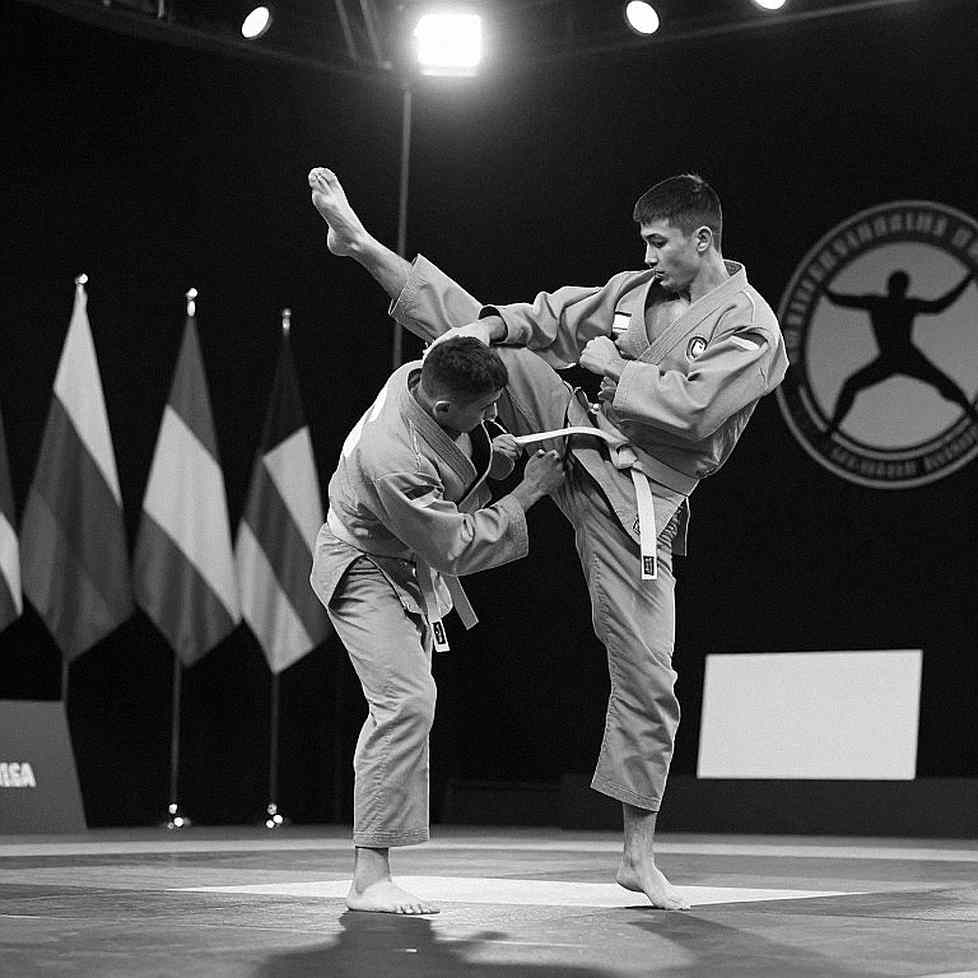
The scoreboards stopped me right after that. Against Iran, Vietnam averaged 8.54, Iran 8.12 — a gap of 0.42. Against Chinese Taipei the margin was thinner still: 8.24 against 7.92, a gap of 0.32.
The gold now circulating in headline language as an emphatic victory was not won by a wide points margin; it was won by a unanimous decision. That distinction is not decorative. In team kata, all five judges landing on the same side means a close performance still did not split the panel. But a margin of zero point four two means the distance between the two finalists was the width of a sheet of paper.
That is where my real question formed. If the difference was that small, how did the verdict come back unanimous?
Context
Confusion about team kata has a reason. Two teams never face each other. Three athletes perform a set kata together — set sequence, set breathing, set tempo. Judges assess technical accuracy, power, speed, rhythm, balance and the three athletes' synchronisation. There is no knockdown, no blood, no clinch. The team that errs less and shows more unity wins. Under World Karate Federation rules this is an entirely judged event, which is why the judges' cards are the match documents here.
The chapter before Nagoya was Hangzhou. At the 2026 Asian Games, Vietnam's women's team kata squad won gold with Nguyen Ngoc Tram, Nguyen Thi Phuong and Luu Thi Thu Uyen. The coach was Nguyen Hoang Ngan, whom Vietnamese media call the kata queen. Vietnam arrived in Nagoya carrying the burden of a title defence.
The squad, though, did not stay identical. Phuong and Luu dropped out; Hoang Thi Thu Uyen, 20, and Bui Ngoc Nhi, 19, came in. Tram is now 24 and the most experienced face in the trio. The athlete who was the youngest in 2026 dragged the team through in 2026.
The competitive field shifted too. Four countries entered women's team kata at Asiad 19. In Nagoya it reached eight. The named list includes representatives from Nepal, Chinese Taipei, Iran, Thailand, the Philippines, Macau, Malaysia, Cambodia and Brunei. Iran beat Thailand and the Philippines on the way to the final, so the final opponent was not hollow.

Core analysis
From outside it is a clean story: defending champion, new squad, same gold. Inside, the arithmetic breaks into three layers.
Layer one, the quarterfinal. A 5-0 result against Nepal proves no contest. In team kata, when two teams are far apart the five cards become near-identical because comparison barely arises. This one match weights Vietnam's overall statistics but does not test the team's real ceiling. Anyone drawing conclusions from a three-match average walks the wrong road.
Layer two, the semifinal. Against Chinese Taipei, 8.24 against 7.92. One detail stands out: on the cards, scores spread from 8.0 to 8.5. The panel members did not weigh the same thing equally. Some valued technical form, some athletic power. In kata judging that is normal, and it tells us that a unanimous verdict did not mean identical reasoning. [Confidence: Low]
Layer three, the final. Against Iran, 8.54 against 8.12. The opponent was credible, yet Vietnam took all five cards. That unanimity likely reflects the team's presence — when three athletes' breathing, clapping and pauses match exactly, the panel rarely finds room to split. [Confidence: Medium]
This is where I hit my own limit. Which kata the team performed, what difficulty tier it carried, and in what proportion the judges weighted technical against athletic components — none of it appears in the published information. Without kata names, difficulty categories or execution-error detail, a deeper technical ranking is impossible. The phrase overwhelming performance is the language of a report, not the product of independent technical analysis.
Let me settle one brutal count. Three matches, five judges each — fifteen cards. Not one went to Iran or Chinese Taipei. In as subjective a discipline as kata, total unanimity across fifteen cards is rare, because the same kata usually draws different numbers from different panels. That unanimity is praise for Vietnam's synchronisation, and it also draws the boundary: consensus proves how clean a team was, it does not prove how far ahead of the opponent it was.
What can be read sits elsewhere. The three ages are 24, 20 and 19. That shape gives a squad the material for at least one more cycle — one mature anchor and two rising athletes. Two members changed from the 2026 squad and the title still held, which means Vietnam's women's team kata has at least one working selection process that produces athletes rather than depending on a single exceptional coach.
That conclusion, though, is still inference. The current coaching staff is not named in the reporting. No injury, layoff or peaking data exists. Weight-cutting and wear in the combat-sports sense do not apply to kata, so risk on that axis is nil; but without public information on camp quality, funding and selection rules, praise for the system stops halfway.
The organisational layer matters here. Karate runs under the Olympic Council of Asia and the World Karate Federation umbrella. There are no free agents, no promoters, no contract auctions. Athletes arrive through national federation selection, and after the medal their livelihood depends on the state structure. This cannot be compared with the professional boxing or MMA market. A gold ornament can be lost inside three years if the selection process and coaching seats are absent.
Standing here, I pull in my own country's ledger, because the comparison is merciless.
At the 2026 Dhaka South Asian Games, Bangladesh won four karate golds — the country's most successful discipline at a record nineteen-gold Games. Eight years later, in a series I wrote, the only question was this: did any of those four medallists find a paying pathway? The answer was no. Four karate golds asked a question no pathway could answer. After the 2026 split from BJKF to BKF, committees changed, coaches changed, and the athletes stayed exactly where they were.
In 2026, when the National Sports Council gymnasium emptied, Army, Police and BGB athletes kept training behind closed doors while private clubs shut one by one. The empty stadium taught me that silence has a first bell — and that it sounds not like a flag being raised but like a coach's phone going dead.
The gap between Vietnam and Bangladesh is not talent. The gap is a process. Vietnam's squad produces medals across consecutive editions because continuity of selection, early planning for generational change and a coaching structure that survives a title sit at its centre. In our system the committee dissolves after every edition and the athletes return to the same question — what did this medal give me.
Contrarian angle
I could be wrong, in three ways.
First, I am treating an eight-country field as serious competition. In reality, going from four to eight means several of the new four have not yet reached a competitive level. A bigger field in kata is good news, but it is not proof of depth. The quarterfinal against Nepal is evidence of that.
Second, kata numbers measure reputation as well as performance. An unconscious generosity toward defending champions operates in panels — not deliberate, but present. Whether Iran would have taken all five cards by delivering an identical kata, we do not know. Without that information, treating unanimity as final proof is exaggeration.
Third, reading a process story, I may mistake one generation's talent for a process. Tram, Uyen and Nhi arriving together may not be the product of management at all. They may simply be three exceptional athletes who coincided in time. There is one way to know: in the next cycle, does Vietnam hold the same numbers after Tram leaves?
Takeaway
This Nagoya gold makes Vietnam the reference team in team kata right now. What to watch in the next edition is not the medal but two questions. One: does the women's team kata field move from eight to twelve, and if it does, can Iran, Thailand or Chinese Taipei bring the 0.42 margin down to zero? Two: as Tram moves from 24 to 28, do we see her inside a salaried coaching structure or a domestic kata league?
I count the seconds because every athlete is somebody. On the Rajshahi rooftop, ninety seconds became a way of listening. And if by 2029 none of these three holds a salaried coaching seat or a domestic kata league inside Vietnam, this gold too returns to the old question — the medal exists, the pathway does not.